Retiring in Cyprus: How to Invest When Markets Are High
Planning retiring in Cyprus ? Discover how to invest safely when markets hit record highs, avoid sequence risk, and build a bucket strategy tailored to expat life on the island.
Yannick
7/9/202610 min read


Retirement in Cyprus: How to Invest with Confidence When Markets Are at All-Time Highs
Moving to Cyprus for retirement usually conjures images of seaside walks in Paphos, terrace lunches in Limassol, gentler taxation, and a Mediterranean pace of life. But one question comes up almost immediately when the topic of wealth management arises:
Should you really invest now, when markets seem to be at their peak?
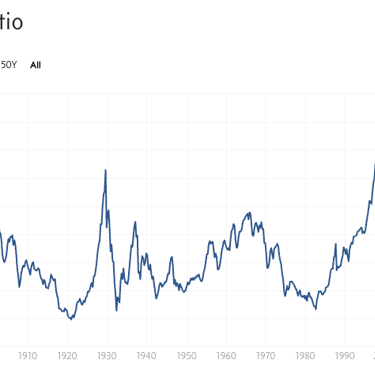
That concern is understandable. The Shiller CAPE ratio for the S&P 500 has been hovering around historically high levels — roughly 41 according to recent data (July 2026) — meaning U.S. stocks are expensive relative to their average earnings, adjusted for inflation, over the past decade.
But here's the thing: an expensive market isn't a good enough reason to stay frozen in cash. As Rob Berger regularly points out in his retirement investing content, the real challenge isn't predicting the next crash. The real challenge is building a portfolio that can survive multiple scenarios — growth, stagnation, sharp declines, inflation, or an unexpected recovery.
Here's an expanded, structured version tailored for a French-speaking expat preparing for or already living in retirement.
Why All-Time-High Markets Scare Future Retirees
During the accumulation phase, a market downturn can actually be an opportunity: you keep investing, you buy at lower prices, and time works in your favor.
But once you retire, the logic flips.
You're no longer necessarily adding money to your portfolio. Instead, you start withdrawing from it to cover:
housing;
healthcare expenses;
food;
travel;
leisure activities;
insurance;
everyday living costs.
This is where the fear becomes rational. If the market drops right after you retire, you may be forced to sell assets at a loss just to cover your expenses.
And that's exactly what you want to avoid.
The Real Danger for Your Retirement: Sequence Risk
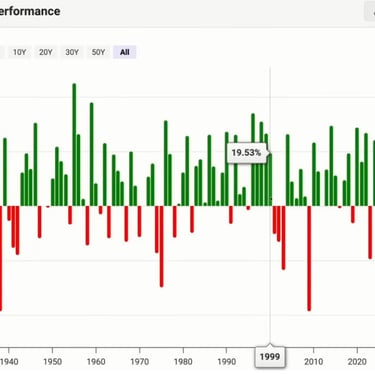
The biggest risk for a retiree isn't simply "the market goes down." The real danger is called sequence of returns risk.
In plain terms, it's not just the average return over 30 years that matters — it's the order in which good and bad returns occur.
A Simple Example: Tim and Tony
Imagine two retirees, Tim and Tony.
Both have:
the same starting capital;
the same portfolio;
the same annual expenses;
the same average return over 30 years.
But they don't experience those returns in the same sequence.
Tony starts his retirement during a bull market. His portfolio grows in the early years. Even as he withdraws money, that initial growth protects his capital. He can comfortably afford his apartment in Paphos or his evenings out in Larnaca without significantly weakening his portfolio.
Tim, on the other hand, starts his retirement right before a 20%, 30%, or 40% crash. To pay his rent in Limassol, his groceries, and his insurance, he has to sell ETF shares while they're deeply down. Those shares will never participate in the eventual recovery.
Result: even with an identical average return over the long run, Tony may end up with a comfortable portfolio, while Tim could burn through his capital much faster.
This is the risk retirees need to manage first and foremost.
What Not to Do: Sell Everything Out of Fear of a Crash
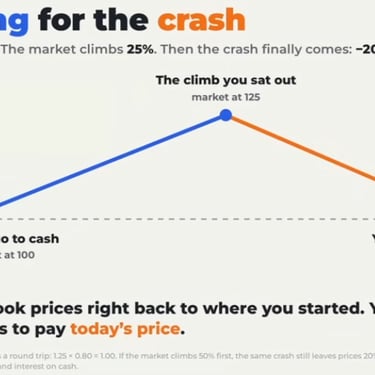
Faced with high valuations, the temptation is strong: "I'll move everything to cash and wait for the market to drop."
On paper, this seems prudent. In reality, it's often dangerous.
Why? Because it requires getting two nearly impossible decisions right:
Selling at the right time;
Buying back in at the right time.
Markets can stay expensive for a long time. They can also keep climbing despite high valuations. And even when a crash does happen, it's psychologically very hard to reinvest in the middle of the panic.
Rob Berger often stresses this point: market timing is rarely a reliable strategy for funding retirement. In his article on the bucket strategy and the 4% rule, he notes that selling all your stocks in a down market can be catastrophic for a retiree. (robberger.com)
The right approach, then, isn't to guess the next market top. It's to build an allocation that keeps you from being forced to sell stocks at the worst possible moment.
The Solution: Organize Your Wealth Using a "Bucket" Strategy
The bucket strategy involves dividing your capital according to the time horizon of your needs.
The idea is simple: money you'll need tomorrow shouldn't be invested the same way as money you won't need for 20 years.
For a retired expat, this method is particularly valuable because it combines:
cash safety;
steady income;
diversification;
long-term growth;
psychological peace of mind.
Bucket #1: The "Paycheck" Bucket — 6 to 12 Months of Expenses
This first bucket covers your immediate expenses.
It can include:
checking account;
savings account;
money market fund;
very short-term term deposit;
readily available cash.
Its purpose isn't to grow your wealth — it's to keep you from stressing.
Specifically, this bucket should cover roughly 6 to 12 months of regular expenses:
housing;
food;
electricity;
water;
fuel;
health insurance;
restaurants;
leisure;
short trips.
Example
If your monthly budget in Cyprus is €3,000, your "paycheck" bucket might hold between:
€18,000 for 6 months;
€36,000 for 12 months.
This bucket lets you live without having to sell investments every week or every month.
Bucket #2: The Safety Reserve — 2 to 5 Years
The second bucket is your crash-proof reserve.
It should cover several years' worth of net expenses — meaning the expenses your other income sources don't already cover.
For example, if you have:
€2,500 in monthly expenses;
€1,500 in pension or rental income;
you're short €1,000 per month, which needs to come from your portfolio.
Your annual net need is therefore €12,000. A 3-year reserve would represent roughly €36,000.
This bucket can be held in conservative vehicles:
high-quality short-term bonds;
conservative bond funds;
term deposits;
money market funds;
possibly high-quality government bonds.
Rob Berger frequently mentions a cash or conservative-asset cushion covering several years of expenses, specifically to avoid being forced to sell stocks during a downturn. In his simplified approach, he refers to a cash bucket covering roughly three to five years of needs, after accounting for income sources like pensions.
Bucket #3: Diversifiers to Cushion the Shocks
The third bucket reduces your dependence on a single engine: large U.S. stocks.
Depending on your profile, it can include:
international bonds;
listed or physical real estate;
commodities;
gold;
value stocks;
small caps;
emerging markets;
conservative multi-asset funds.
Note: this bucket doesn't need to be complex. For many retirees, a simple allocation of global stocks + quality bonds is already enough.
The key idea is this: don't rely solely on the S&P 500, especially when U.S. stocks are richly valued.
Bucket #4: The Growth Bucket to Outpace Inflation
The fourth bucket funds your retirement over 15, 20, or 30 years.
It mainly contains growth assets:
global equity ETFs;
developed market ETFs;
emerging market ETFs;
small-cap ETFs;
possibly listed real estate.
This bucket will fluctuate. It can lose 20%, 30%, or more during a crash. But its role is essential: protecting your purchasing power against inflation.
Because staying entirely in cash isn't risk-free either. Inflation quietly erodes your capital. Even in Cyprus, where the cost of living can be gentler than in France on certain items, your expenses can still rise over time: healthcare, housing, energy, food, insurance.
S&P 500 or World ETF: Beware of Recency Bias
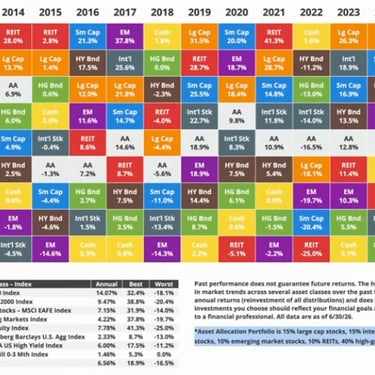
Over the past several years, many investors swear by the S&P 500 alone. It's understandable — large U.S. companies have strongly dominated global markets in the recent period.
But that recent dominance creates a psychological trap: recency bias.
We end up believing that what worked best yesterday will necessarily work best tomorrow.
History shows that cycles change.
Between 2000 and 2011, for example, the S&P 500 went through a long rough patch, especially after the dot-com bubble burst and then the financial crisis. During that time, other market segments sometimes held up better or outperformed: emerging markets, small caps, international stocks, bonds.
For a retiree based in Cyprus, whose expenses are likely in euros, being 100% concentrated in large U.S. stocks can expose you to several risks:
excessive valuation risk;
EUR/USD exchange rate risk;
U.S. political risk;
sector risk tied to tech concentration;
risk of prolonged U.S. underperformance.
A more balanced approach involves using global ETFs such as:
MSCI ACWI;
FTSE All-World;
MSCI World + emerging markets;
a combination of developed + emerging market equities.
The goal isn't to predict which region will win. The goal is to avoid depending on a single country.
Which ETFs to Favor When Living in Cyprus?
For a tax resident of Cyprus, and more broadly for any European resident, it's generally preferable to favor UCITS ETFs domiciled in Europe, often in Ireland.
Why?
Because American ETFs like VOO, VTI, or SPY can create several issues for non-U.S. residents:
sometimes limited access through European brokers;
potentially unfavorable U.S. estate tax exposure;
reporting less suited to European residents;
administrative complexity;
dollar exposure that isn't always well managed.
UCITS ETFs are designed for European investors and are generally better suited to a French-speaking expat living in Cyprus.
Examples of ETF Categories Worth Considering
Without giving personalized recommendations, here are the broad useful categories:
global equity accumulating ETFs;
short-term euro bond ETFs;
euro-hedged global bond ETFs;
emerging market ETFs;
global listed real estate ETFs;
euro money market ETFs.
For a Cyprus resident benefiting from the non-dom regime, taxation on dividends, interest, and capital gains can be particularly attractive — but it depends on your personal situation. It's therefore best to validate your strategy with a local tax advisor before rebalancing your portfolio.
Example Allocation for a Retiree in Cyprus
Here's a purely educational example for a moderate-risk retiree with a 25- to 30-year horizon. An overall allocation might look like:
10% cash;
25% bonds and money market;
10% diversifiers;
55% global equities.
For a more conservative profile, the equity portion could drop to around 40–50%. For a more aggressive profile, it could rise to 60–70%. William Bengen's research on historical withdrawal rates points to equity allocations often ranging between 50% and 75%, depending on risk profile.
The 4% Rule: Useful, But Not Magic
The 4% rule is often presented as an absolute truth. In reality, it's a starting point.
It comes from research by William Bengen, who studied sustainable withdrawal rates on historical U.S. portfolios. The general idea: withdrawing 4% of your capital in year one, then adjusting that amount for inflation, would historically have allowed a balanced portfolio to survive most 30-year periods. Rob Berger points out that Bengen's original study assumed a portfolio made up of stocks and intermediate-term bonds, rebalanced annually.
But in real life, your situation is likely more nuanced.
You might have:
a French pension;
a supplementary retirement plan;
rental income;
a company;
substantial capital;
flexible expenses;
different tax treatment;
a paid-off primary residence;
private health insurance;
children you occasionally help financially.
The 4% rule shouldn't be applied mechanically. It should be adapted.
Spending With Confidence Thanks to "Guardrails"
Many retirees make the opposite mistake of over-withdrawing: they never dare to spend.
They're afraid of running out. As a result, they live an overly restrictive retirement, even as their portfolio keeps growing.
That's a shame — especially in Cyprus, where the early years of retirement can be the richest in experiences:
exploring mountain villages;
traveling to Greece, Lebanon, Italy, or France;
enjoying the beaches off-season;
upgrading your home;
hosting your children and grandchildren;
trying local restaurants and activities.
A smarter approach involves using dynamic guardrails.
Example of a Simple Method
You set a target annual spending amount — say, €48,000 per year.
Then you apply some rules:
if the portfolio grows strongly, you increase spending by 5–10%;
if the portfolio drops sharply, you temporarily cut non-essential spending by 5–10%;
you don't touch essential expenses;
you mainly adjust travel, leisure, restaurants, and big purchases.
This method helps you avoid two extremes:
panicking with every downturn;
depriving yourself unnecessarily when your portfolio is doing very well.
Good to Know: Cash Is Reassuring, But It's Not Enough
Cash is psychological insurance, not a growth strategy.
Having 6 months, 12 months, or even several years of expenses set aside can be very useful. But keeping 100% of your wealth in cash for 20 or 30 years exposes you to another risk: loss of purchasing power.
Even with moderate inflation, your real capital shrinks over time.
The goal, then, isn't to choose between "all cash" or "all stocks." The goal is to build a balanced wealth structure:
enough liquidity to sleep soundly;
enough bonds to weather the storms;
enough global equities to fund the long term;
enough flexibility to adjust withdrawals.
A Concrete Action Plan for an Expat in Cyprus
Here's a simple 7-step method.
1. Calculate your real annual budget in Cyprus
Include:
housing;
healthcare;
insurance;
food;
car;
travel;
taxes;
leisure;
family support;
unexpected expenses.
2. Subtract your guaranteed income
For example:
French pension;
supplementary retirement income;
rental income;
annuity;
business income;
recurring dividends.
3. Calculate the amount you'll need to withdraw from your portfolio
This is the figure that really matters for sizing your buckets.
4. Build your cash bucket
Aim for 6 to 12 months of expenses.
5. Build your crash-proof reserve
Aim for 2 to 5 years of net needs, depending on your risk tolerance.
6. Invest the rest according to a global allocation
Avoid excessive concentration in a single country, sector, or currency.
7. Rebalance once a year
Rebalancing forces you to sell some of what's gone up and add to what's gone down. It's a simple but powerful discipline.
Conclusion: The Market May Be Expensive, But Your Plan Needs to Be Solid
Yes, U.S. markets are expensive. Yes, a crash could happen. Yes, starting retirement right before a downturn is a real risk.
But the solution isn't to stay frozen in cash while waiting for the perfect entry point.
The right strategy is to build a portfolio capable of surviving uncertainty:
a cash cushion for peace of mind;
a conservative reserve to avoid forced selling;
global diversification so you're not solely dependent on the S&P 500;
UCITS ETFs suited to European residents;
a flexible withdrawal rule;
dynamic adjustments based on market conditions.
Your retirement in Cyprus shouldn't hinge on the Fed's next move, the Nasdaq's next record, or the next anxiety-inducing headline in the financial press.
It should rest on a written, simple, diversified plan tailored to your real life.
FAQ
Should I invest if markets are at an all-time high?
Yes, but not carelessly. A market at an all-time high can keep climbing for years. Rather than trying to find the perfect moment, it's better to invest according to an allocation suited to your time horizon, risk tolerance, and income needs.
How much cash should I keep in retirement in Cyprus?
A reasonable baseline is to keep 6 to 12 months of expenses in cash, then 2 to 5 years of net needs in conservative vehicles. The exact amount depends on your pensions, your budget, and your ability to temporarily reduce spending.
Which ETFs should I choose when living in Cyprus?
For a European resident, UCITS ETFs domiciled in Europe are generally better suited than American ETFs. Global equity ETFs, short-term bond ETFs, euro bond ETFs, and money market funds can form a solid base, depending on your profile.
Are you preparing to move to or retire in Cyprus? Take the time to build your wealth plan before you leave — not once you're already settled and under pressure.
👉 Important note: This article is educational and does not constitute personalized financial, tax, or legal advice. Before adjusting your allocation, tax residency, or withdrawal strategy, consult a qualified financial and tax advisor in Cyprus.

Images