
How Much Money Do You Need to Retire Early?
Wondering how much you really need to retire early in Cyprus? We break down the safe withdrawal rate, lifestyle budgets, and Cyprus's 0% tax advantage for retirees.
Yannick
6/30/20264 min read
How Much Money Do You Really Need to Stop Working?
Who hasn't dreamed of walking away from it all at 40 or 50, spending their days sipping an iced frappé on a Peyia beach or wandering the narrow streets of Paphos's old town? Retiring at any age is no small thing. It's a massive commitment to your future self.
But one question keeps coming up: how much money do you actually need to stop working today?
Whether you're aiming to retire at 30, 40, or 50, this isn't something to leave to chance. Let's pull out the calculators and talk numbers, strategy, and Mediterranean lifestyle.
🧮 The Magic Retirement Equation
Faced with the fear of running out of money at 85, we need a concrete formula. In personal finance, everything comes down to this deceptively simple equation:
Target Capital = Annual Expenses / Safe Withdrawal Rate
For this formula to work, we need to nail down two crucial variables: how much you'll spend, and what percentage of your capital you can withdraw each year without running yourself into the ground.
📉 The Famous "Safe Withdrawal Rate" (SWR)
How much can you pull from your investment portfolio each year without ever emptying it before you die?
For decades, the financial world swore by the "4% Rule" (born from the well-known Trinity Study). In theory, if you have €1 million, you can withdraw €40,000 in your first year, adjust that amount for inflation each year after, and your capital should last at least 30 years.
The catch? Thirty years of retirement works fine for someone stopping at 65. If you retire at 35 under the Cypriot sun, your capital needs to last 50 or 60 years.
For a very early retirement, the 4% rule is too risky given how unpredictable markets can be. Experts today recommend a much more conservative rate if you're young:
Retiring at 20-40: aim for a withdrawal rate of 2% to 2.5%
Retiring at 50-60: you can push it to 2.5%-3%
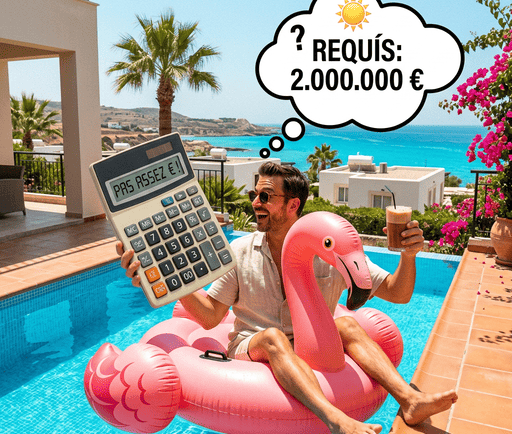
In practical terms: if you need €40,000 a year to live, at a cautious 2% rate, you'd need €2 million in capital — not €1 million as the old 4% rule suggested. That stings, but it's the price of safety.
My honest take: I lean toward the conservative end of this range, especially if you're retiring in your 30s or 40s. I've seen too many people get comfortable with 3.5-4% "because it worked historically" — but historical data has limits, and sequence of returns risk is brutal in the early years. Better to overshoot your target slightly than to find yourself recalculating everything at 55.
💶 How Much Will You Actually Spend Each Year?
This is the most subjective part of the equation. Your expenses in Paris, Brussels, or Geneva won't look anything like your expenses in Paphos.
To give you a rough idea (based on European standards adjusted for local cost of living), here are three lifestyle profiles for a couple:
Bare minimum (survival in the sun): ~€25,000/year. Covers the essentials, local groceries, the occasional taverna — nothing extravagant.
Moderate (Cypriot comfort): ~€40,000/year. Regular outings, a decent car, weekends in the Troodos mountains, and vacations back in Europe.
Comfortable (the good life): ~€60,000-80,000/year and up. Villa with a pool, travel, dining out without checking the bill.
Important: these figures assume your primary residence is fully paid off. If you're still renting — say €1,500 a month for a nice apartment in Limassol — that adds €18,000 to your annual expenses. At a 3% withdrawal rate, that rent alone means adding €600,000 to your starting capital.
💡 GOOD TO KNOW: The Cyprus Tax Advantage. This is where Cyprus genuinely stands apart from the rest of Europe. If your retirement is funded by investment income (dividends), becoming a Cypriot tax resident under the "Non-Domiciled" status means you pay 0% tax on your worldwide dividends and interest for 17 years. On top of that, Cyprus doesn't tax capital gains on assets like accumulating ETFs. Compare that to France, where the flat tax (PFU) now takes 31.4% of your gains (up from 30%) — in Cyprus, €40,000 in dividends or ETF gains means €40,000 net in your pocket. That difference alone can dramatically shrink the capital you need to retire.
This is genuinely one of the biggest levers available to European early retirees, in my view — but it's not a silver bullet. You still need to structure things properly, meet residency requirements, and factor in that tax rules can and do change. Don't treat 0% as a permanent guarantee; treat it as today's very favorable reality.
🏛️ The Myth of the State Pension
If you're planning to stop working at 40, forget about the state pension. You won't have contributed enough quarters, and you won't have access to it before 64 (possibly later by the time you get there).
For your early retirement calculations, the safest approach is to treat any state pension as a possible future "bonus" — but base your core equation on €0 in state support.
🌉 The "Bridge" Strategy
A strategy commonly used by expats who retire early is building a "bridge."
Instead of relying on one enormous lump sum, you calculate what you need to cover the gap between your retirement age (say, 45) and the age at which other funds become accessible (locked life insurance policies, retirement savings plans, or the legal retirement age).
If you need €30,000 a year for those 15 "bridge" years, that's a far more manageable sum to reach — and simply spend down — than trying to generate infinite returns forever.
🌅 So, Is It Actually Realistic?
Retiring at 30 or 40 requires serious savings discipline and fairly aggressive investing (think global index funds). The numbers can be intimidating at first glance.
But here's the thing: once you understand the equation, optimizing it becomes almost a game. Moving to a country with a gentler cost of living and genuinely favorable taxation, like Cyprus, is often the "cheat code" that cuts the time needed to reach financial independence roughly in half.
Is it right for everyone? No. Uprooting your life for tax optimization only makes sense if you actually want to live here — the weather, the pace, the culture, the occasional frustrations with bureaucracy included. I'd be wary of anyone treating Cyprus purely as a tax play without factoring in the lifestyle fit.
So, what about you? At what age are you planning to stop working, and what would your ideal budget be to live under the Cyprus sun? Let me know in the comments below. 👇